Experiencing Italy — A First-Timer’s Itinerary — Florence
Days Six to Eight of your Italian Adventure — Leave Venice in the morning, It’s a three-hour train ride from Santa Lucia station to Florence Santa Maria Novella, which gets you there in the middle of the day.
The Land of the Medici

The Medici emblem decorates buildings throughout Florence.
Although Florence has a long history dating back to the Etruscan-Roman period, it was not until the 15th century that the capital of the Tuscan region earned its renown as the Cradle of the Renaissance. This reputation is mainly due to one powerful family: the Medici, a dynasty that began with the founding of the Medici Bank in 1397. It was to dominate the Florentine political life for three centuries; and shape Florence into one of Europe’s major artistic, and cultural centers.
Where to Stay?

The Palazzo Vecchio is the iconic image of medieval Florence.
Florence is a compact, easily walkable city that developed within the protection of its medieval walls, now gone except for some of its monumental towers. Everything you’ll want to see is within a mile from everything else, and it’s packed with tourists. For a convenient location in the heart of this historic center yet away from the frenzy, consider the area around the Piazza Santissima Annunziata (a 15-minute walk from the train station). There are accommodations of all types available in the immediate neighborhood. Most notably, the Loggiatto dei Serviti is an excellent hotel right on the eastern side of the piazza. Located in a fully renovated 15th century convent, the property consistently gets high marks for its understated elegance, impeccable comfort and superb service.
First Impressions

The porticoed facades were designed by Fillipo Brunelleschi..
Start off by taking in the exquisite harmony of the porticoes surrounding three sides of the Piazza Santissima Annunziata. Right across from the hotel, note the Ospedale degli Innocenti (Hospital of the Innocents), Europe’s first orphanage, with its Della Robbia medallions. The north side of the piazza is defined by the Basilica della Santissima Annunziata (Basilica of the Most Holy Annunciation). Then head south, past the huge equestrian bronze statue of Ferdinando I de’ Medici (circa 1608) to the Via dei Servi, toward the cupola of the Duomo.
Santa Maria del Fiore

The Duomo if entirely clad in pink, green and wihite marble.
The Cathedral Santa Maria of the Flowers (a.k.a the Duomo) is one of the largest churches in the world. With its outside entirely decorated with green, pink and white marble panels, and its soaring octagonal dome by Filippo Brunelleschi the largest brick and mortar dome in the word (114.5 m or 375.7 ft high and 45.5 m or 149 ft in diameter), it is also one of the most spectacular. A few steps farther, the matching marble-clad octagonal Baptistery with its three sets of elaborately sculpted bronze doors, is also a unique work of art.
Keep walking toward the river and the Ponte Vecchio (Old Bridge), the iconic covered bridge that has been straddling the Arno since 1345. Along the way you will get a first look at most of the “guide book musts”, so you can decide which ones you’ll want to explore further.
Piazza della Signoria

the Piazza della Signoria has been the political heart of Florence since medieval times.
The political heart of Florence since the Middle Ages, the vast expanse of the Piazza della Signoria (Square of the Rulers) remains to this day the city’s most significant gathering place for locals and tourists alike. Find yourself a table at the terrace of the historic Caffé Rivoire. A local institution since 1872, it boasts a panoramic view of the monolithic silhouette of the Palazzo Vecchio, its entrance marked by the colossal white marble statue of David by Michelangelo (Actually it’s an exact copy, the original having been moved indoor to the Galleria dell’Accademia in 1873). Then, on the side adjoining the Uffizi Gallery, the elegant Loggia dei Lanzi showcases a stunning open air collection of ancient and Renaissance statuary.
The Uffizi Gallery

The cortile (internal courtyard) of the Uffizi is open to the Arno.
If you ever entertained the idea to overindulge on Renaissance art, a visit to the Uffizi (Offices) is for you! Originally commissioned by Cosimo I de’ Medici in 1560 to consolidate his governing power, the building was intended to accommodate in one central place the various administrative bodies of the city, hence the name of Offices. The top floor was made into a gallery to house the rich Medici collection of Roman sculptures. After the House of Medici died out in 1743, the last heiress bequeathed their entire art collections to the city of Florence. The Uffizi was officially opened to the public in 1769. One of the most important museums in Italy, it is world-renowned for its collection of priceless works, particularly from the period of the Italian Renaissance.
Palazzo Vecchio

The Palazzo Vecchio is a fortified medievial fortress.
The massive medieval structure with its 94m (308ft) tower, was built in the 13th century, as the seat of government of the Republic. In these turbulent times when the frequent power conflicts tended to end in violence, it also needed to be secure and defensible. The Palazzo della Signoria (Palace of the Rulers), as it was then called, retained its original function until 1540, when Duke Cosimo I de’ Medici ordered a restructuring and decoration of the building to make it his residence. It acquired its present appearance and became the Palazzo Ducale (Ducal Palace). It was renamed Palazzo Vecchio (Old Palace) when Cosimo I later moved his residence across the Arno to the Pitti Palace.

The Renaissance courtyards were designed by Giorgio Vasari.
The Palazzo Vecchio is an intriguing place to visit. In addition to its elegant courtyards, it is filled with beautifully frescoed rooms, private apartments, secret passages and the legendary Salone dei Cinquecento (Hall of the Five Hundred), intended hold the 500 members the Consiglio Maggiore (Grand Council). Decorated by Vasari, it is reflection of the boundless ambition of Cosimo I. Here, all the paintings and frescoes are about celebrating the victories of the new Duke as he conquers every city in Tuscany.
Basilica di Santa Croce

Giovani Cimabue – Crucifix (circa 1287). Basilica di Santa Croce.
Another absolute must, just a 10-minute walk from the Duomo, the Basilica of the Holy Cross is the principal Franciscan church in Florence. It houses the burial chapels of some of the most illustrious figures of the Renaissance, including Galileo, Michelangelo and Machiavelli, as well as 19th century musical great Giacomo Rossini. It is also home to the incandescent Giotto polychrome altarpiece of the Coronation of the Virgin (circa 1328). The Neo-Gothic marble façade was added in the mid-19th century.
Local Atmosphere

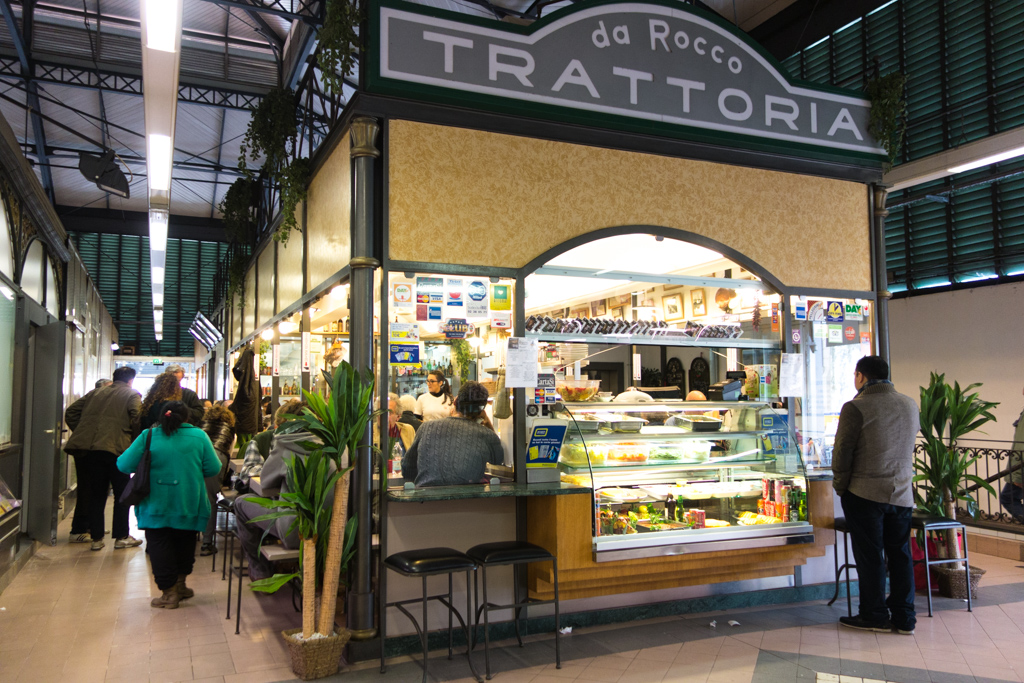
Trattoria da Rocco is a popular feature of the Mercato..
Another few minutes’ walk takes you off the usual tourist track to the lively Sant’Ambrogio neighborhood, at the eastern end of the historic center. The Mercato Sant’Ambrogio, the oldest market in Florence has been the go-to spot for neighborhood shoppers since 1883, for meats, cheeses, fish and fresh produce as well as household goods and basic clothing. At the center of it, the popular Da Rocco trattoria is overflowing with Tuscan specialties and a great place for a casual lunch.

Take a gelato break at Vivoli..
Another Florence not-to-be-missed tradition, just a stone’s throw from Santa Croce, is a gelato break at Vivoli where, since 1929, four generations of the Vivoli family have been creating all natural homemade ice cream with high quality ingredients produced on the family farm.
Across the River

The Ponte Vecchio -view from the upper floor of the Uffizi.,
At some point during your stay, you’ll want to reserve at least half a day to explore the Oltrarno (quite literally the other side of the Arno). Developed outside the city’s walls, the Oltrarno was from the start a neighborhood of artisans, especially fullers, dyers and tanners who needed water from the river. Other trades followed, and their legacy lives on, along the narrow streets lined with shops where the last traditional Florentine craftspeople carry on. They are the engravers, gilders, enamelers and restorers of fine antiques. Other still bind books, make marbled paper and fine hand-made leather goods.
Early Renaissance Landmarks

Details of frescoes by Masolino and Masaccio (circa 1427).
Wander to the Basilica di Santo Spirito (Basilica of the Holy Spirit). It’s interior is one of the purest examples of early Renaissance architecture in Florence. Then continue on to the Church of San Fedriano. It is slightly out of the way but it is home to the Brancacci Chapel, with its ground-breaking cycle of frescoes by Masolino and Masaccio (circa 1427). They were the first to embrace perspective and light to create a realistic human dimension, and open the way for future generations of artists.
Palazzo Pitti

Florence skyline view from the terraces of the Palazzo Pitti.
Purchased in 1550, the Palace was chosen by Cosimo I de’ Medici and his wife Eleanor of Toledo as the new Grand Ducal residence. To that end, it was expended into the sprawling 32,000 square meter (eight-acre) residence that we know today, Eleonora also oversaw the addition of the sumptuous amphitheater-shaped Boboli Gardens at the rear of the palace.

Boboli Gardens – Fountain of Neptune.
For the next two centuries, the palace remained the primary residence of the Grand Dukes and the symbol of the Medici’s power over Tuscany. It also became an unimaginable treasure trove as the family accumulated artworks, jewels, china and furniture. Today is it the largest museum complex in Florence, with a rich collection spanning six centuries and including dedicated silver, porcelain, costume and carriage museums as well as painting and sculpture galleries.
The gardens have become an outdoor sculpture museum that includes roman antiquities as well as Renaissance works.

Panoramic view of the Ponte Vecchio
Good to Know
- Visiting — Throughout the peak tourist season (especially June to October) long lines can plague the most popular sights in Florence. To make the most of your time in the city, plan well ahead by consulting the official website of the ticket office of the Florentine state museums and purchasing advanced tickets.
- Churches — All the churches mentioned in this story are active places of catholic worship. They are typically open to visitors Monday through Saturday during the day and only at restricted hours on Sunday. Opening hours vary based on the schedule of religious services. Detailed information is usually provided on their official website. There is no charge to enter churches but there is a charge for specific additional visits such as the dome of the Duomo, adjoining cloisters or frescoed chapels. Note — There is a dress code to enter all churches in Italy. Both men and women are required to cover their knees and upper arms. This prohibits wearing shorts or skirts above the knee, sleeveless tops and low-cut shirts.
A Few Souvenirs